
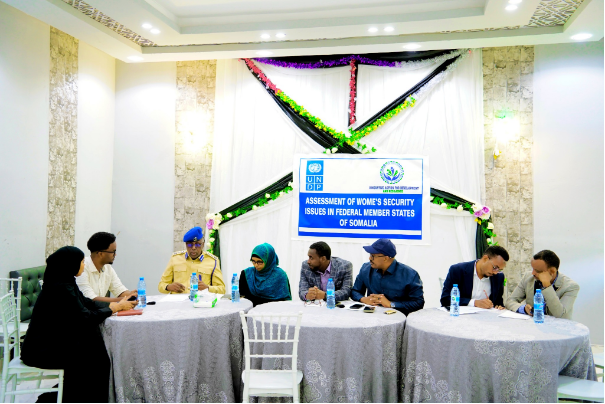
Innovative Action for Development and Resilience (IADR), with support from UNDP, has completed a Women’s Security Needs Assessment across four Federal Member States of Somalia: Galmudug, Hirshabelle, Jubaland, and South-West State.
The assessment was designed to better understand the security challenges facing women and girls, identify gaps in protection and justice systems, and generate practical recommendations for strengthening women’s safety, access to services, and participation in peace and security processes.
The assessment brought together a wide range of stakeholders, including government institutions, security actors, civil society organizations, community representatives, and women’s networks. Through these consultations, participants discussed women’s security priorities, institutional response gaps, and opportunities to improve coordination between communities, government actors, and protection service providers.
Implemented from 28 May to 30 November 2025, the assessment used a qualitative approach that included desk review, key informant interviews, focus group discussions, and stakeholder consultations. These methods helped capture community-level perspectives as well as institutional insights from security and governance actors.
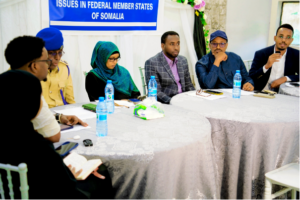
Findings from the assessment show that women continue to face overlapping security risks, including gender-based violence, displacement-related vulnerability, clan-related insecurity, limited access to formal protection services, and barriers to meaningful participation in security and justice processes.
Women and community representatives also shared local perspectives on safety, protection, reporting pathways, and the barriers faced by women and girls when seeking support or justice.
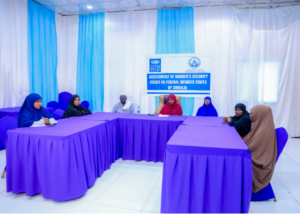
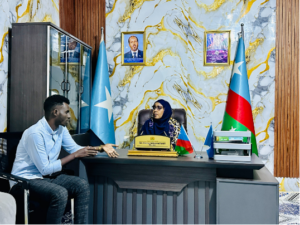
The assessment also included key informant interviews with female security officers and other security sector representatives. These interviews provided important insights into women’s security concerns, service accessibility, institutional capacity, and the role of female officers in survivor-centered response.
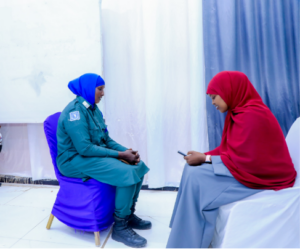
Field interviews with security sector representatives highlighted practical experiences related to women’s protection needs, community trust in security services, and the importance of improving gender-sensitive policing and referral mechanisms.
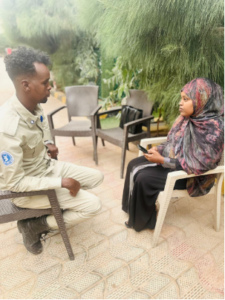
Consultations with frontline security actors further helped document women’s safety concerns and identify opportunities to strengthen reporting systems, referral pathways, and institutional responses to protection cases.
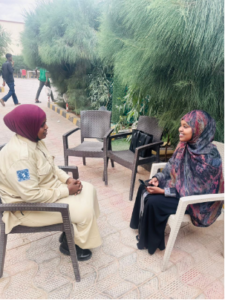
A key informant interview with a police representative contributed to the assessment’s evidence base on institutional readiness, women’s access to protection services, and existing capacity gaps within the security sector.
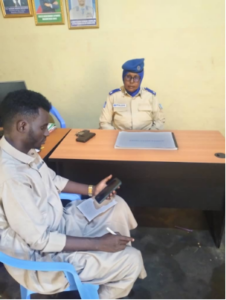
Engagement with government leadership also supported the assessment’s objective of strengthening coordination and developing evidence-based recommendations for women’s security and participation in Somalia’s security sector.
The assessment recommends stronger gender-responsive security frameworks, increased deployment and training of female security officers, safe reporting mechanisms, improved government-CSO referral systems, legal and policy reforms, and expanded survivor support services.
IADR also recommends conducting similar assessments in the remaining locations of Somalia to support the development of a country-level women and security framework.